

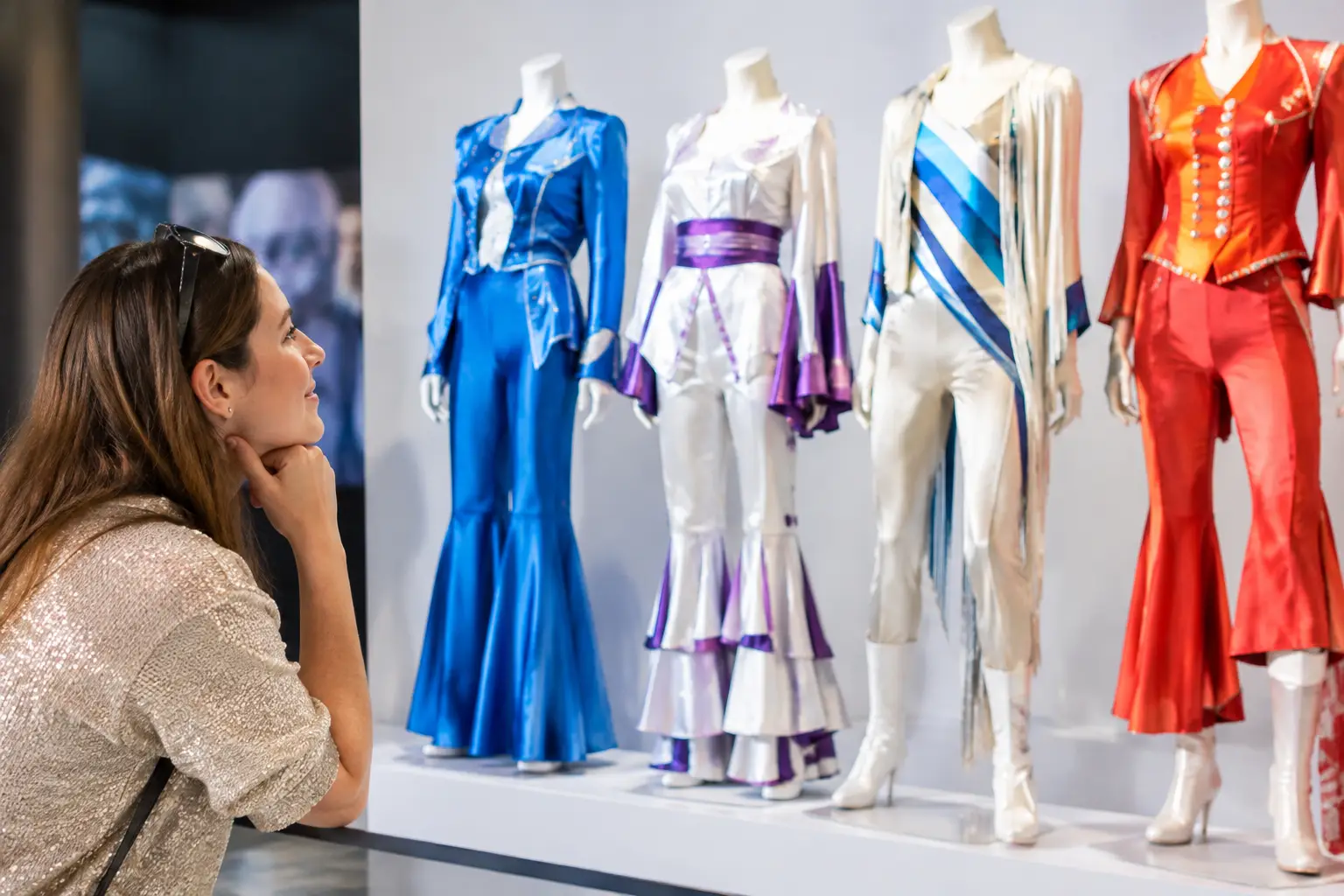
Those white catsuits, the star shaped trousers, the capes, the towering boots and the unapologetic glitter were never simply clothes. So, who designed ABBA stage costumes? The key name is Swedish designer Owe Sandström, whose fearless ideas helped turn Agnetha, Björn, Benny and Frida into one of pop’s most instantly recognisable visions.
For fans, the costumes are part of the sound. Think of the opening piano of Dancing Queen, the drama of Mamma Mia, or the pulsing optimism of Waterloo. In the mind’s eye, the music arrives with colour, sparkle and silhouettes as bold as the songs themselves. Sandström understood that ABBA did not need to look like any other group. They needed to look like ABBA.
Who designed ABBA stage costumes in the classic years?
Owe Sandström designed many of ABBA’s most celebrated stage costumes during their great 1970s run, particularly from the middle of the decade onwards. His work gave the group a unified visual identity while still allowing each member’s personality to shine through.
Agnetha’s looks could feel romantic, bright and glamorous. Frida often carried a more dramatic, theatrical edge. Björn and Benny were not placed in anonymous suits at the side of the stage either. They wore costumes with just as much confidence, from patterned jumpsuits to flares, satin and shining boots. That equality mattered. ABBA presented four distinct figures, not two singers with a backing band.
Sandström’s designs were made for movement and impact. They had to read clearly under powerful lights, register with audiences at a distance and feel memorable on television, where ABBA became a fixture in homes across Europe and far beyond. A tiny flourish that might disappear in everyday clothing could become magical on camera.
The most famous examples include the white and gold costumes associated with the Dancing Queen period, the bright blue and white looks from the late 1970s, and the dazzling outfits that made every television appearance feel like an event. They were playful, excessive and beautifully controlled. Even when the clothing was wildly imaginative, it still made visual sense as part of the group’s world.
Why ABBA’s costumes were so daring
ABBA emerged at a moment when pop fashion was full of experimentation. Glam rock, disco, platform shoes, synthetic fabrics and bold stage presentation were all in the air. Yet ABBA’s look was not a borrowed version of anyone else’s. The group’s wardrobe had a distinctly Swedish sense of colour and fantasy, blending theatrical costume with pop polish.
Sandström used glitter, metallic fabrics, embroidery, feathers, bold prints and dramatic shapes with real purpose. The costumes made ABBA visible. On a crowded television variety programme, a conventional outfit might have faded into the background. A silver cape or a pair of white knee high boots announced, within seconds, that this was something special.
There was also humour in the designs. ABBA could be glamorous without becoming distant. Their outfits invited delight. They made viewers smile, and they gave fans something to talk about long after a performance had ended. That is not a small achievement. Pop style often dates quickly, but ABBA’s most extravagant looks remain joyful because they never pretend to be ordinary.
The costumes also suited the group’s musical contrasts. Fernando called for romance and mystery. Tiger could carry a fiercer edge. Thank You for the Music had a stage musical warmth. Sandström’s work did not flatten those moods into one uniform image. It helped ABBA move between them while remaining unmistakably themselves.
The Swedish tax story, with a little context
One story is repeated whenever people discuss ABBA’s stage clothes: Swedish tax rules reportedly allowed performers to claim clothing as a business expense only if it was so distinctive that it could not reasonably be worn in ordinary life. This has led to the familiar joke that ABBA dressed so wildly because it was tax deductible.
There is some truth behind the tale, but it should not be treated as the full explanation for the costumes. The group’s visual ambition was much bigger than a tax calculation. The designs were part of a carefully considered pop presentation, and their theatricality was a creative decision first. The tax rules may have encouraged extravagance at the edges, but they did not invent the imagination behind it.
More than one person shaped the ABBA look
It is fair to name Owe Sandström as the central costume designer of ABBA’s iconic 1970s image. It is less accurate to suggest that one person created every garment the group ever wore. ABBA worked for many years, across recording sessions, television performances, tours, photographs and changing musical eras. Stylists, makers, photographers, hairdressers, make up artists and the members themselves all contributed to the finished picture.
The four members also knew what felt right for them. A costume could be striking on a sketch, but it still had to work for singing, dancing, travelling and facing a television camera. Frida and Agnetha, especially, had to perform in clothes that carried glamour without distracting from the vocal performance. Björn and Benny needed clothing that looked part of the same story, rather than an afterthought.
That is why the best ABBA costumes feel so alive. They do not look like museum pieces that happened to make their way onstage. They look as though they belong to the songs, the performers and the moment.
From Eurovision winners to pop style icons
The Eurovision performance of Waterloo in 1974 introduced ABBA’s appetite for visual flair, even before the group’s most celebrated Sandström designs became established. Their bright outfits, platform footwear and youthful confidence matched a song that burst with colour. Winning the contest gave ABBA an international stage, and their fashion soon became part of the invitation.
As the hits grew bigger, the imagery became more assured. The group did not settle into a safe formula. Costumes evolved with the music, from the cheerful exuberance of the mid 1970s to the more polished, dramatic mood of the later albums. The pop world was changing, and ABBA changed with it, while preserving that essential flash of fantasy.
This is one reason their style still works. The costumes are rooted in their era, certainly, but they are not trapped there. They have become visual shorthand for confidence, melody and the pleasure of putting on a show. Modern performers regularly borrow the same lesson: if a song makes people feel larger than life, the visual presentation can meet it there.
The costumes still belong to the fans
Walk into an ABBA themed party, a tribute show or a Eurovision gathering and you will see Sandström’s influence everywhere. A white jumpsuit, a cape, a flash of blue satin or a glittering pair of boots can transform an ordinary evening into a shared celebration. Fans do not copy these looks because they are trying to recreate the past exactly. They wear them because the clothes still carry the feeling of the music.
That feeling has travelled through generations. Someone who remembers watching ABBA on a television set in the 1970s may see those costumes as a vivid piece of personal history. Someone who found the group through Mamma Mia! or the Voyage concerts may see them as pure pop fantasy. Both responses are valid, and both are part of why ABBA endures.
For listeners streaming the magic of ABBA, the costumes offer another route into the songs. Put on Dancing Queen and picture the white, the gold and the lights. Play Gimme! Gimme! Gimme! and imagine the sharp silhouettes and disco shimmer. The music does the essential work, of course, but the imagery makes the memory glow a little brighter.
Owe Sandström gave ABBA a wardrobe worthy of their melodies: daring enough to be unforgettable, generous enough to make every fan feel invited to join the celebration.
Post comments (0)